A WordPress Development Agency You Can Actually Call
Custom WordPress themes, bespoke plugins and real integrations, built in-house by a UK team. No purchased themes, no page builders, a fixed quote before we start, and the code is yours.
Some of our direct clients







Why Businesses Choose Us for WordPress
Custom themes, bespoke plugins and real integrations built in-house by a UK team you can speak to directly, with a fixed quote before anything starts.
Custom Themes, Never Templates
Every site is built from scratch around what it actually has to do. No commercial theme bent into shape, no page builder locking your content into someone else's format.
Fixed Quotes Up Front
We scope the work properly and price it before anything is built, so you know what you are committing to and there are no surprises halfway through.
UK Team, In-House
Every project is built by our own developers in the UK. Nothing is passed to a third party, and you speak directly to the people writing the code.
You Own Everything
The theme, the plugins we write, the hosting, the accounts. It is all handed over at the end, documented, with no licences tying you to us.
Built to Be Edited
The admin only shows the fields your team needs. Content updates should not require a developer or a training session to get right.
Support That Continues
Updates, monitoring, backups and a developer to call. Launch is the start of the site's life, not the end of the relationship.
The Platforms We Build and Connect
Custom WordPress at the core, with WooCommerce, membership systems and the CRMs, accounting tools and APIs your site needs to talk to. Where a project genuinely outgrows WordPress, we build it on Laravel instead.

Laravel & Bespoke Platforms
For systems and platforms that require bespoke processes, data handling complex integrations or internal business platforms with security at the forefront of the build.

WordPress & WooCommerce
For fast, reliable and easy to manage brochure based websites built following best practice with a bespoke theme powered by ACF Pro and supporting custom built plugins.

Shopify & Shopify Plus
For eCommerce and retail brands looking to grow revenue significantly online. Built using a bespoke theme specific to your brand and with a full seamless migration from legacy platforms.
Recently Completed Projects
Clintons Cards
A full migration from Magento 2 to Shopify Plus, with order, customer, product, stock and finance integrations kept live through the switch.
Ecommerce · Shopify Plus · Integrations
QualityHive
A Laravel platform that web agencies use to capture, assign and close website bugs, taken from wireframe to launch, then handed over as clean, documented code.
SaaS platform · Laravel · API integrations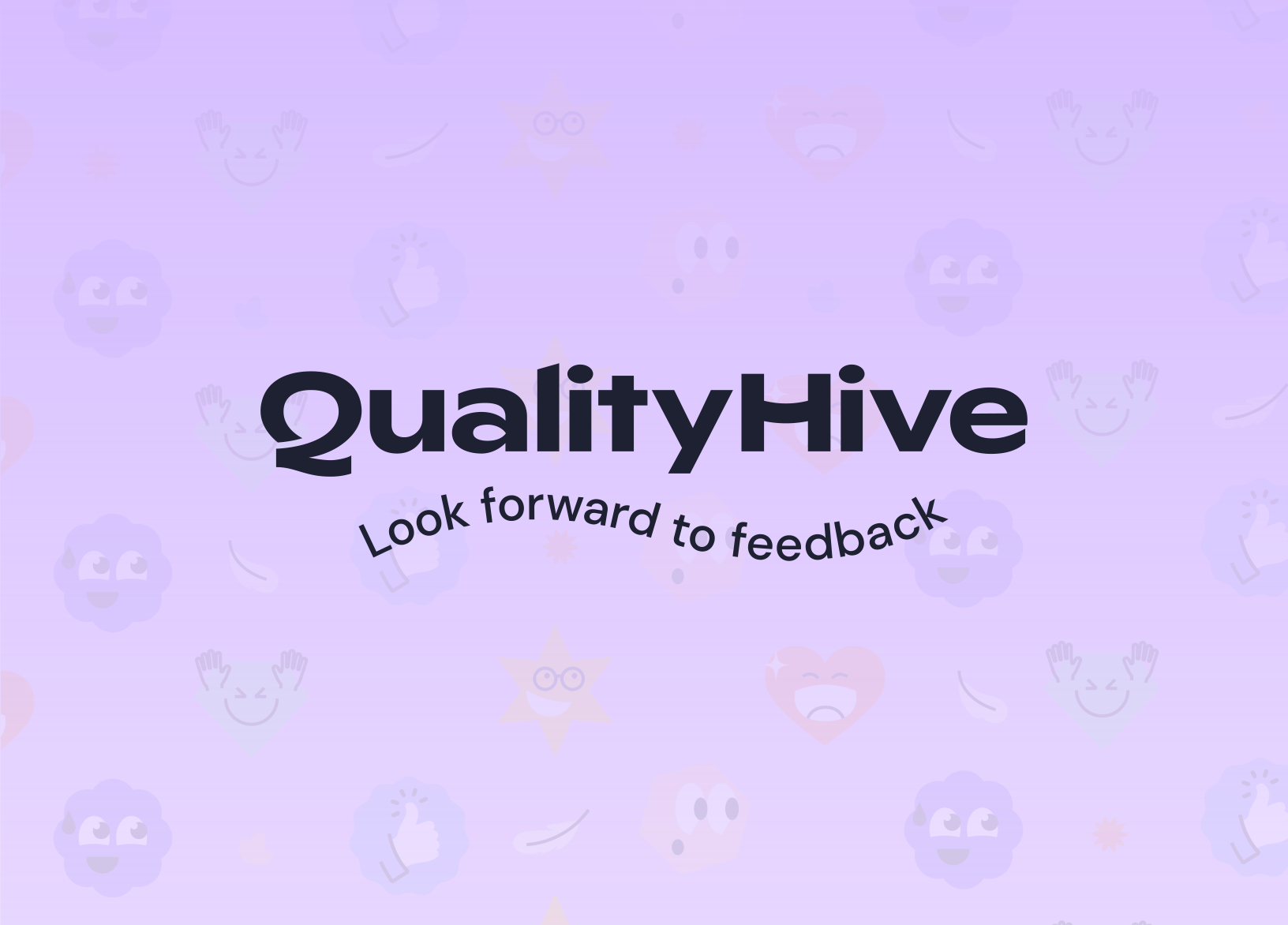
The Sauce Foundry
A brand, a WooCommerce store and product photography for an artisan hot sauce startup, launched to a 3.8% conversion rate from day one.
Ecommerce · Branding · WooCommerce
Have a project like these in mind?
Get in touchHere's What Our
Clients Say
Consistently rated 5* on Google by our full build clients and retainer clients.
Zestcode really have proven to be “website design & development specialists” whilst maintaining the very best customer service. Not easy to find a well-rounded company like Zest these days that tick all the boxes. 5*

Head of Marketing, Masterclip
After working with Zestcode for over 2 years I wouldn’t trust any other web developers. An agency that are committed to getting the project right and going above and beyond expectations.

Director, Novus Digital
Harry and his team have just finished producing our new website, his team have done an amazing job producing our website and their continuous communication throughout made the process a lot easier.

Director, JL Phillips
The whole process was efficient, fast and incredibly well managed. Communication was clear throughout, they understood exactly what we were trying to achieve, and they delivered without unnecessary delays or complications.

Director, Teaching Tomorrow
The main project Zestcode did for us was developing our bespoke Laravel system, which involved complex API integrations and secure data management. They were knowledgeable, responsive and easy to work with throughout.

Managing Director, Heath Crawford
Zestcode are a superb web design and development agency. Everything they produce is top quality. Harry is super responsive, always gets back to you quickly, and is an absolute pleasure to work with.

Marketing Manager, Which Health Cover
Working with Zestcode has been a genuinely positive experience from start to finish. What stood out most was how much time they took to understand how the project would fit into our existing processes before diving in. Rather than just building to a spec, they asked the right questions upfront.

Marketing Manager, Roof Maker
Zestcode Digital have just finished my website and I am beyond thrilled with it! I highly recommend their services not only are they professional and proficient but incredibly helpful.

Director, Select Art Gallery
It's an easy and enjoyable process working with Zestcode Digital, highly recommended.

Director, Whoisvisiting
Their team is highly responsive, especially in time-sensitive situations, and their ability to deliver reliable solutions quickly has been a huge asset. I wouldn’t hesitate to recommend them to anyone looking for dependable web development support.

Marketing Manager, Slick Gorilla
Having close communication with Harry throughout the whole project has been invaluable. He always makes sure to explain things thoroughly and helped me understand all the different aspects of the project that I needed to know.

Director, All Abroad
Frequently Asked Questions
Hiring a WordPress Development Agency
Most people arrive at this page with the same handful of questions: what will actually be built, whether the site will still be easy to live with in three years, and what it costs to keep it running. Here is how we answer all three.
What a WordPress development agency actually does
Almost every web company will tell you it works with WordPress, because almost every one does. The gap is between installing a commercial theme and configuring plugins around it, and building a site from the ground up around what your business needs. The first is assembly. The second is development, and it is the difference between a site you can grow into and one you replace in two years.
We build custom themes, write bespoke plugins where WordPress falls short, connect the site to the other systems you run, and stay involved after launch. Everything is built in-house in the UK, and you speak to the developers rather than an account manager relaying messages.
WordPress is one of several stacks we work in. If a project turns out to be better served by something else, we will say so rather than forcing it, and our wider web design and development work covers the alternatives.
Custom themes rather than page builders
A commercial theme ships with code for every use case its author could imagine, and your site loads all of it whether it uses any of it or not. A page builder adds another layer on top, storing layout inside your content in a proprietary format that is painful to leave. Both feel fast at the start and expensive later.
A custom theme contains only what your site needs. The markup is clean, which helps both performance and accessibility. The admin exposes only the fields your team will actually use, which means fewer ways to break a page. And when the site is redesigned in four years, your content is stored as content rather than as builder markup, so it moves with you.
Where a site needs behaviour WordPress does not offer natively, we write a bespoke plugin for it instead of stacking third-party ones that overlap and conflict. Keeping that logic in a plugin rather than the theme means a future redesign does not put the functionality at risk.
Ecommerce, memberships and the awkward cases
Plenty of WordPress projects are more than a marketing site. Membership and gated areas where access control has to be right, content-heavy publishing sites with real taxonomies and archive templates, multilingual setups, and sites with custom post types that the standard editor handles poorly on its own.
Where a project needs a shop attached, that moves into WooCommerce development, including stores that have to talk to stock, accounting or fulfilment systems rather than sitting on their own.
Occasionally a requirement genuinely outgrows WordPress, usually when it is closer to an application with users, permissions and workflows than to a website. That is portal and platform development, which we build on Laravel. We will tell you when a project has crossed that line rather than pushing WordPress somewhere it does not belong.
Not sure what your project involves?
Send us what you have, even if it is only a rough idea. We will tell you plainly what it would take and roughly what it would cost, with no sales pitch attached.
Making WordPress talk to your other systems
A website is rarely the only system a business runs. Enquiries need to reach a CRM, stock and pricing need to come from somewhere, customers need to reconcile with accounting. We build those connections directly against each vendor's own API through our API integration work, rather than chaining together automation tools that fail silently and cost more as volume grows.
Common ones we handle repeatedly include syncing HubSpot with WordPress so form submissions land as contacts with the right properties attached, and OpenAI integrations where content or search inside the site benefits from it.
The test we apply is simple: if a person is copying data between two systems every week, that is a job for an integration.
Speed, hosting and security
Speed is a build decision, not a plugin you install afterwards. We keep themes lean, load only what a page needs, handle images properly, and configure caching sensibly. Where a site is already slow, our WordPress speed optimisation work measures before and after rather than making changes and hoping, and our write-up on why a WordPress site ends up slow covers the usual culprits.
Hosting is often the real problem. Cheap shared plans put a hard ceiling on what any amount of optimisation can achieve, which is a pattern we see often enough to have written about WordPress on shared hosting specifically. Moving to properly configured hosting, whether that is a migration to DigitalOcean or an OpenLiteSpeed setup, frequently produces a bigger improvement than anything done in the code.
Security follows the same logic. A small, current plugin set, sensible permissions, WordPress and PHP kept up to date, and backups that have been tested by actually restoring them. If a site has already been compromised, WordPress hack repair is a separate job with its own process, and cleaning it up properly means finding how they got in, not just removing what they left.
What happens after launch
A WordPress site is not finished at launch, it just changes shape. Plugins update, WordPress ships new versions, and the business asks for changes. Left alone, that is exactly how a site drifts into being slow, broken or insecure, usually discovered at the worst possible moment.
We can hand a site over cleanly with documentation and step away, or stay on. Our WordPress support retainers cover updates, monitoring, backups and a set amount of development time each month, so there is a developer to call rather than a scramble. If you are weighing up what such an arrangement should include, we have written about what belongs in a website support retainer.
Where a site collects personal data or runs analytics, we also handle cookie consent and GDPR setup properly, rather than dropping in a banner that blocks nothing.
If you are an agency rather than an end client
A good share of our WordPress work never carries our name. Agencies that win WordPress projects but do not want permanent development staff use us as their build team, invisibly, with the client relationship staying entirely theirs.
That arrangement is set out in full on our white label WordPress development page, and if you would rather think of it as capacity than as a branding exercise, outsourcing WordPress development covers the same ground from that angle. Where a client runs several sites from one installation, WordPress multisite setup is usually the thing to ask about first.
The technical standards are identical either way. The only thing that changes is whose name is on the work.
Partner with Zestcode for Industry Leading Quality and Reliability
Tell us what you're looking for and we'll see how we can help. Quotes are typically provided within 2 working days of the initial call.